


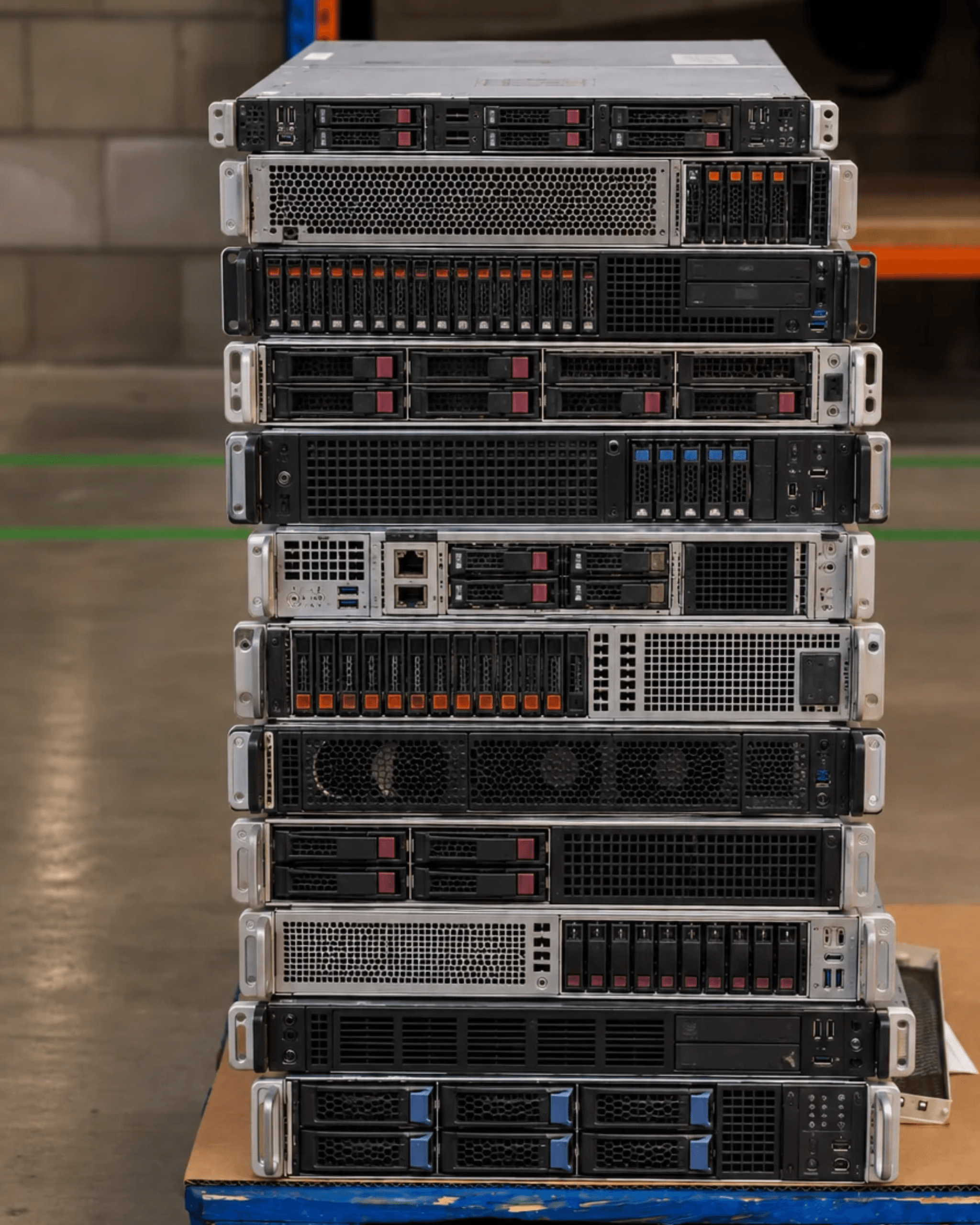
Disposing of old servers: what happens once they’re switched off?
Disposing of old servers involves more than just unplugging the cables. They may still contain sensitive data, and the hardware may still be of value. How do you ensure they are disposed of safely, whilst also finding a new home for any usable equipment?
When it comes to making IT more sustainable, a great deal of attention is paid to energy consumption and cooling. What happens to equipment after it has been used also deserves consideration. After all, a server that is replaced within your organisation may not necessarily have reached the end of its useful life.
At Reuzado, we help organisations take that next step. We assess the possibilities for reuse and ensure that the data is processed appropriately. This is how data security and circularity come together.
Decommissioned servers may still have some value
Servers are replaced for various reasons. An organisation may be growing, applications may have different requirements, or the IT infrastructure may be being upgraded. That does not automatically mean that the existing equipment is unusable.
The same server may still be suitable for another organisation or application. Individual parts may also be of value, such as memory modules and other usable components.
That is why the process of disposing of old servers begins with an assessment of the equipment. What is its technical condition? Can the server as a whole be reused? Which parts are still usable? And what needs to be recycled?
By answering these questions before processing, you can prevent usable hardware from being needlessly lost.
First, securely delete the data
Servers and associated data storage devices may contain sensitive information. This includes business documents, customer data and backups. Switching off or disconnecting a server does not delete this information.
Before equipment is sent on to its next destination, it must be clear how the data will be handled. Depending on the data storage medium and your organisation’s requirements, you can opt for professional data erasure or the physical destruction of the data storage medium.
Once data has been successfully erased, suitable equipment can be reused. Is physical destruction of a data storage device required? If so, a separate assessment is carried out to determine which other components are still suitable for reuse.
In this way, a suitable balance is struck for each device between data security and the preservation of usable hardware.
Ensure that processing can be demonstrated
When disposing of servers, you want to be able to check what has happened to the equipment and the data. A clear record and proof of the data erasure carried out will help with this.
You should therefore establish in advance which equipment is being transferred, what processing is required and what documentation you will receive. Ensure that the records of the equipment collected correspond to the evidence of the processing carried out.
Transport and handover are also part of this process. Who takes delivery of the equipment? When does responsibility pass? And how is the handover documented?
Clear agreements allow you to keep track of the equipment, even after it has left your premises.
Make sure to include the drainage system in your replacement plan
When carrying out an IT upgrade, the focus is often on installing and commissioning the new environment. The old servers are then left in place, for example in a storage room or an unused rack.
By organising the disposal process in advance, you can prevent equipment containing residual data from being stored for longer than necessary. You will also gain an earlier insight into the possibilities for reuse.
You should therefore identify, prior to the replacement, which servers are to be taken out of service, which data storage devices are in use, and what requirements apply to data deletion. You should also agree on who will oversee the handover and where the relevant documentation will be stored.
In this way, the phase-out becomes an integral part of the modernisation of your IT environment.
Reuse where possible, recycle where necessary
A circular approach takes into account the potential of each device. Suitable servers are given a new purpose following secure data erasure. Usable parts can be reused.
When reuse is no longer possible, recycling takes over. The focus here is on recovering materials and ensuring the responsible processing of the remaining components.
At Reuzado, we therefore look beyond the end of the equipment’s useful life within your organisation. We assess what value remains and determine which next step is best suited to the equipment and your requirements.
Disposing of old servers with Reuzado
Reuzado helps organisations with the safe disposal and processing of end-of-life IT equipment. From assessing opportunities for reuse to data erasure and recycling: we look at what the equipment needs to ensure it can be managed responsibly.
Are you planning to replace your servers, or do you still have old IT equipment in storage? Please get in touch with Reuzado. Our experts will be happy to help you find a safe and suitable new home for it.